What is an UPS rectifier?
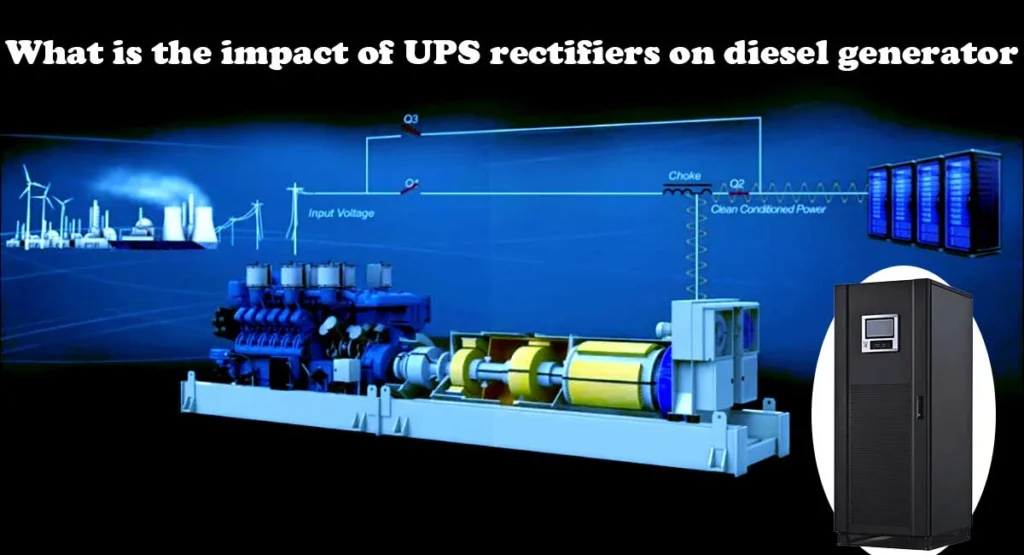
In critical applications such as large data centers and financial hubs, where uninterrupted power is essential, the combination of uninterruptible power supplies (UPS) and diesel generators has become the standard configuration for power assurance. Diesel generators can provide ample power to sustain business operations. Meanwhile, the UPS is used as an intermediate power supply during the transition from mains power failure to backup diesel generator operation. It can switch to battery power instantly when mains power is interrupted, providing electricity to critical equipment before diesel generator power becomes available. But in reality, is the relationship between UPS and diesel generators truly that harmonious? In a UPS system, the UPS rectifier may exert some influence on the generator.
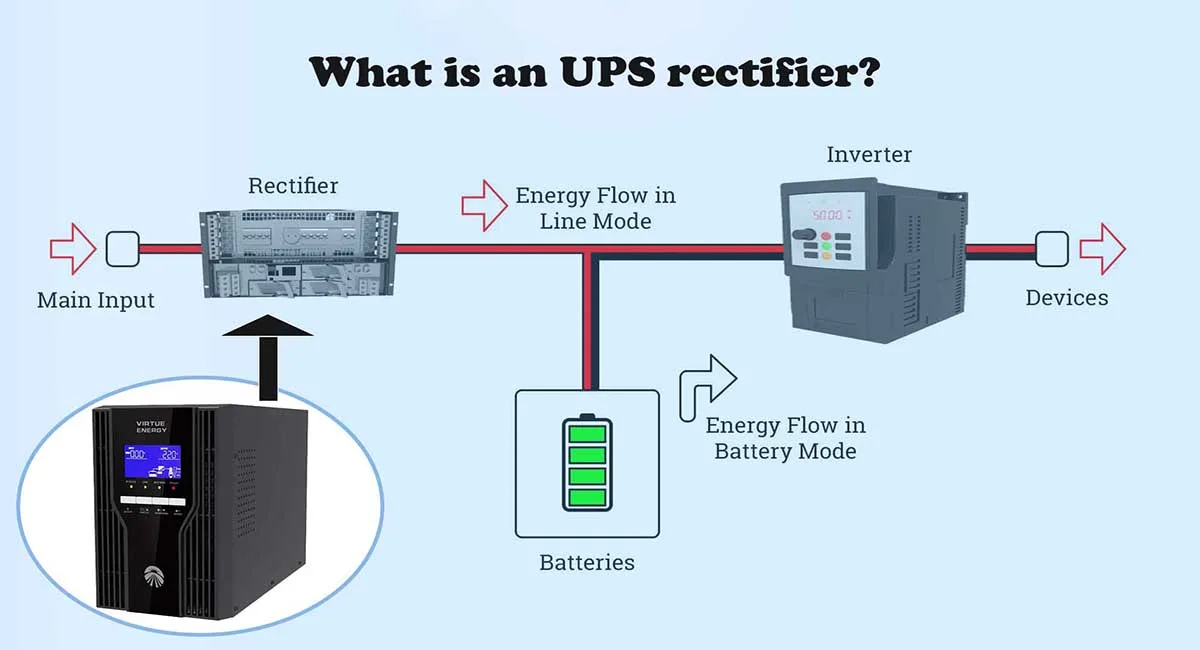
The UPS rectifier is a key component of the UPS system, primarily tasked with converting the AC power from the utility grid into stable DC power. In our 1kVA lithium UPS, the lithium UPS rectifier delivers the converted DC power to the inverter. Then, the inverter transforms this clean, stable DC power into AC power to supply the load. Meanwhile, it also charges the internal lithium iron phosphate battery bank with the converted DC power, ensuring the batteries remain fully charged and ready at all times. When the utility power fails, it will provide stable power support for your critical load equipment. However, when used in conjunction with a generator, what effect does the UPS rectifier have on the generator?
5 impact of UPS rectifier on diesel generator
Causing harmonic current distortion in generators
UPS rectifier is a typical nonlinear load that draws non-sinusoidal currents from the grid or generator. These currents contain a significant amount of high-order harmonics. Therefore, when these currents flow through the generator windings, the generator will generate additional harmonic magnetic fields internally. Furthermore, the flow of harmonic currents through the generator’s internal impedance generates harmonic voltages, leading to distortion in the generator’s output voltage waveform.
Distorted voltage waveforms may be misinterpreted by the detection circuit of the automatic voltage regulator (AVR). It may cause the SCR to turn off at the wrong time, resulting in loss of precise control over the excitation current and triggering output voltage fluctuations or instability. In addition, distorted voltage waveforms can cause abnormal heating in the generator’s stator and rotor. Under such conditions, the generator’s insulation materials will age more rapidly, which will significantly shorten its operational lifespan.
Affecting the voltage stability of generators
When operating under light load or no load conditions, the input filter capacitors or power factor correction (PFC) circuits of a UPS exhibit capacitive load characteristics. This causes an abnormal increase in the output voltage of the diesel generator. Diesel generators are designed for inductive loads. When connected to a capacitive load, the internal inductive armature will interact with the capacitive characteristics of the load. This causes the output voltage to rise uncontrollably, ultimately triggering overvoltage protection and causing the generator to shut down.
Giving the generator an instantaneous shock
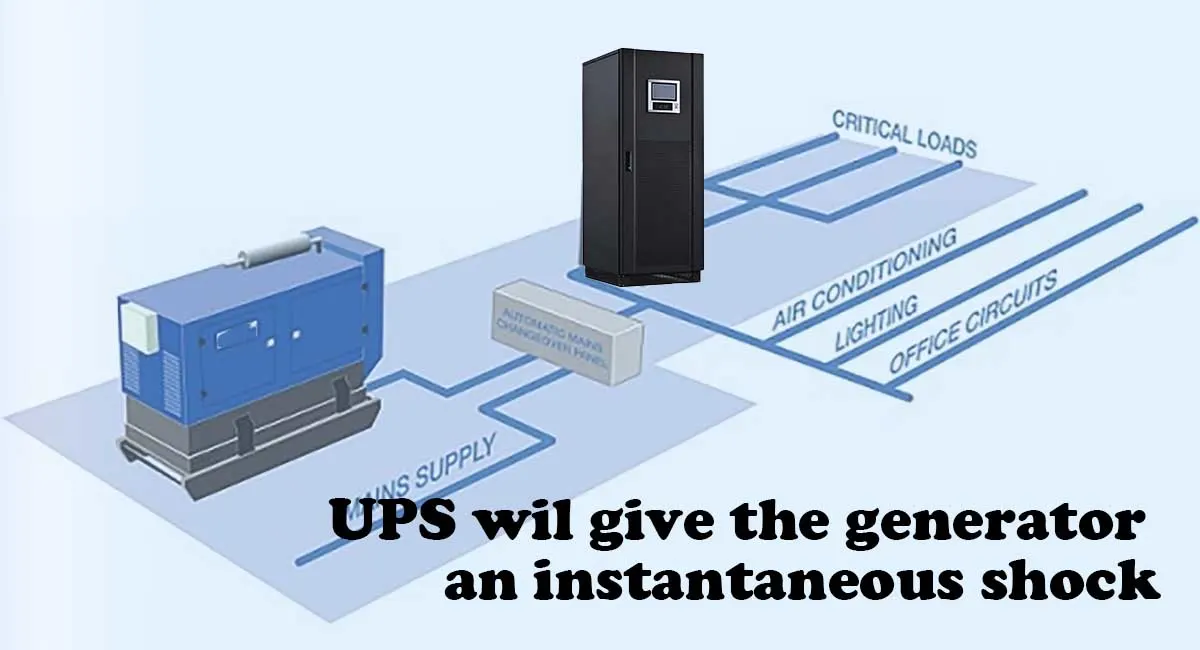
When the utility power fails and the diesel generator starts and stabilizes, the UPS will ramp its load from 0% to 100% within seconds. It is a massive, rapid power surge for the generator. It means the engine must instantly deliver enormous torque to meet the power demand. If the engine lacks sufficient power reserve or the governor responds too slowly, the generator speed will drop sharply. If the frequency falls below the UPS input range, the UPS will determine the power supply is inadequate and switch back to battery power.
Sudden current surges will cause the generator output voltage to momentarily drop. The AVR and excitation system must rapidly apply strong excitation to restore voltage. The governor and AVR of a generator are two closed-loop control systems. Rapid loading of a UPS may trigger interactions between these two control systems, which will generate low-frequency power oscillations, also known as periodic fluctuations in voltage and frequency.
Failing to synchronize the bypass
The static bypass switch of the UPS requires its inverter output to remain synchronized with the generator. If the generator’s voltage or frequency fluctuates excessively or too rapidly, the UPS will deem the power quality unreliable. Thereby disabling the automatic bypass function and triggering a bypass unavailable alarm, which reduces the system’s redundancy reliability.
Making the diesel generator produce excitation and armature reaction
The terminal voltage of a generator is determined by its internal induced electromotive force (EMF), the magnitude of which is proportional to the magnetic flux generated by the rotor excitation current. When the generator is loaded, the load current induces a magnetic field in the stator windings. This field either weakens or strengthens the rotor’s main magnetic field, a phenomenon known as armature reaction. The effect of armature reaction depends on the phase of the load current, specifically whether the load is inductive or capacitive.
When operating with inductive loads, the magnetic field generated by the inductive load current demagnetizes the rotor’s main magnetic field. To maintain constant terminal voltage, the AVR must increase the rotor excitation current to compensate for the weakened main flux. At this point, the generator supplies inductive reactive power to the load. With a capacitive load, the magnetic field generated by the capacitive load current assists the rotor’s main magnetic field. To maintain a constant terminal voltage, the AVR must reduce the rotor excitation current to counteract the enhanced main flux. In this case, the generator absorbs capacitive reactive power from the load. The exchange of reactive power directly determines the direction of AVR regulation on the excitation current. Therefore, maintaining voltage stability essentially involves balancing the effects of armature reaction by regulating excitation.
How to mitigate the impact of UPS rectifier on diesel generators?

Adopts IGBT rectification and active PFC technology
IGBT rectification and active power factor correction (PFC) technology can control the total harmonic distortion (THDi) of the input current below 5% and improve the input power factor to above 0.99. For existing uninterruptible power supply (UPS) systems, installing an active power filter (APF) is a cost-effective solution. It can detect harmonic currents in real time and generate counter-compensation currents, achieving over 90% mitigation effectiveness.
Upgrade lithium UPS system
Compared to traditional solutions, lithium UPS systems can provide significant flexibility in your power protection layout with their reduced footprint and lighter weight. More importantly, the fast response characteristics of lithium batteries perfectly complement generators, effectively smoothing load fluctuations and significantly enhancing system stability. Virtue Energy has experience in numerous projects replacing lead-acid UPS systems with lithium UPS solutions, and can precisely determine the varying generator capacity requirements for different rectifier technologies. For example, traditional 6-pulse rectification requires 2.5-3 times the capacity, 12-pulse rectification requires 2-2.5 times, while modern IGBT rectification requires only 1.25-1.5 times. This precise configuration ensures system stability while avoiding resource waste. If you’re considering upgrading to a lithium UPS solution for your project, we welcome you to contact us.
Intelligent management of UPS and generator sequencing
Through precise timing control, the generator set engages the UPS load in stages only after completing startup and achieving stable operation. For example, a recommended 30-60 second delayed start time disperses concentrated large inrush currents into multiple manageable smaller impacts. Meanwhile, activating the generator mode of the UPS and appropriately relaxing the input parameter range can significantly enhance system compatibility. In lithium uninterruptible power supplies, the built-in intelligent battery management system (BMS) enables deep coordination with the generator. This means the system can monitor battery status in real time, intelligently adjust charging and discharging strategies, and achieve optimal load distribution when powered by the generator.
Conclusion
During the initial stages of building a power protection system, it is essential to consider the selection of UPS units and the compatibility between the uninterruptible power supply system and other equipment. Although UPS rectifier has a certain impact on diesel generators. By understanding equipment characteristics and grasping the principles of system interaction, we can implement scientifically effective measures to achieve harmonious coexistence between UPS rectifier and diesel generators. By understanding equipment characteristics and grasping the patterns of system interaction, we can implement scientifically effective measures to achieve harmonious coexistence between UPS rectifier and diesel generators. Before planning a power protection system for a project, we suggest users across all industries consider these factors in advance. Selecting technologically advanced and appropriately matched equipment helps you ensure that the power supply system can provide continuous and stable power protection for critical operations.