Uninterruptible power supply systems have become critical infrastructure for ensuring stable production in modern industry and normal operations in commerce. However, many customers remain unclear about the differences between industrial UPS and commercial UPS, and are uncertain which one is the most suitable choice. Selecting the right UPS for your project not only relates to equipment purchase costs but also impacts the normal operation of your business. Although both are uninterruptible power supply devices, there are significant differences in product design, technical parameters, and applicable scenarios. Therefore, this article will explain the differences between industrial UPS vs commercial UPS for industrial and commercial customers, helping you choose the most suitable UPS.
Definition of industrial UPS vs commercial UPS
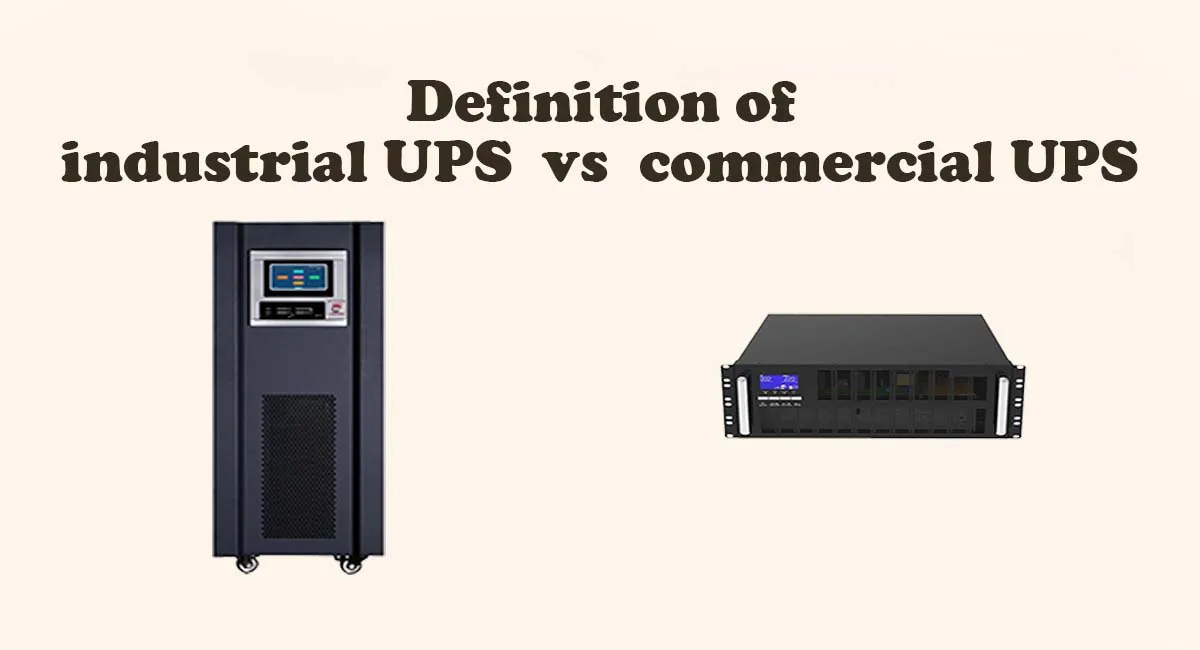
Virtue industrial UPS is designed for industrial scenarios such as production workshops, mining operations, and port machinery. Industrial environments are harsh, for example, some industrial production temperatures can reach as high as 55°C, while in winter temperatures may drop to below -10°C to -20°C. While regular UPS on the market can only operate stably in controlled environments between 0°C and 40°C. But industrial UPS power supply features a wide temperature design, and can work normally within the range of -25°C to 55°C. Additionally, industrial equipment such as motors, welding machines, and lifting equipment will easily generate huge inrush currents during startup and operation. If connected to a standard UPS, it is easy to cause downtime due to the impact of instantaneous current. Industrial UPS can withstand more than 150% instantaneous overload, and supports online maintenance, ensuring the continuity of industrial production.
Commercial UPS is an uninterruptible power supply solution specifically designed for standardized commercial environments such as office buildings and retail spaces. Virtue 1-3kVA UPS is a standard 2U design which can be integrated into standard racks, effectively reducing commercial space requirements. The parameters of commercial UPS systems are specifically adjusted for the characteristics of equipment like servers, surveillance systems, and unmanned checkout systems. So it can deliver stable, clean power while improving energy conversion efficiency, which helps commercial customers keep their operations running smoothly and reduce electricity bills. Moreover, our lithium UPS has a communication function, so you can monitor the device’s operating status anytime for more precise power management.
What is the difference between industrial UPS vs commercial UPS?
Different application scenarios
In manufacturing workshops, mines, and other industrial environments, the operating temperatures of equipment fluctuate significantly and may also be subject to environmental conditions such as humidity, high temperatures, and dust. However, commercial environments typically feature more stable operating conditions. And the biggest pain point for commercial UPS systems is minimizing space requirements and improving energy efficiency. These differing application environments dictate the design and technical parameter distinctions between industrial UPS vs commercial UPS. Although there are obvious differences, there are no inherent superior or inferior option. They simply represent distinct uninterruptible power supply solutions for different application scenarios. Virtue UPS can meet your industrial and commercial power protection needs, and can customize lithium UPS solutions to match your specific project requirements. Please feel free to contact us if you have any needs.
Different power ratings
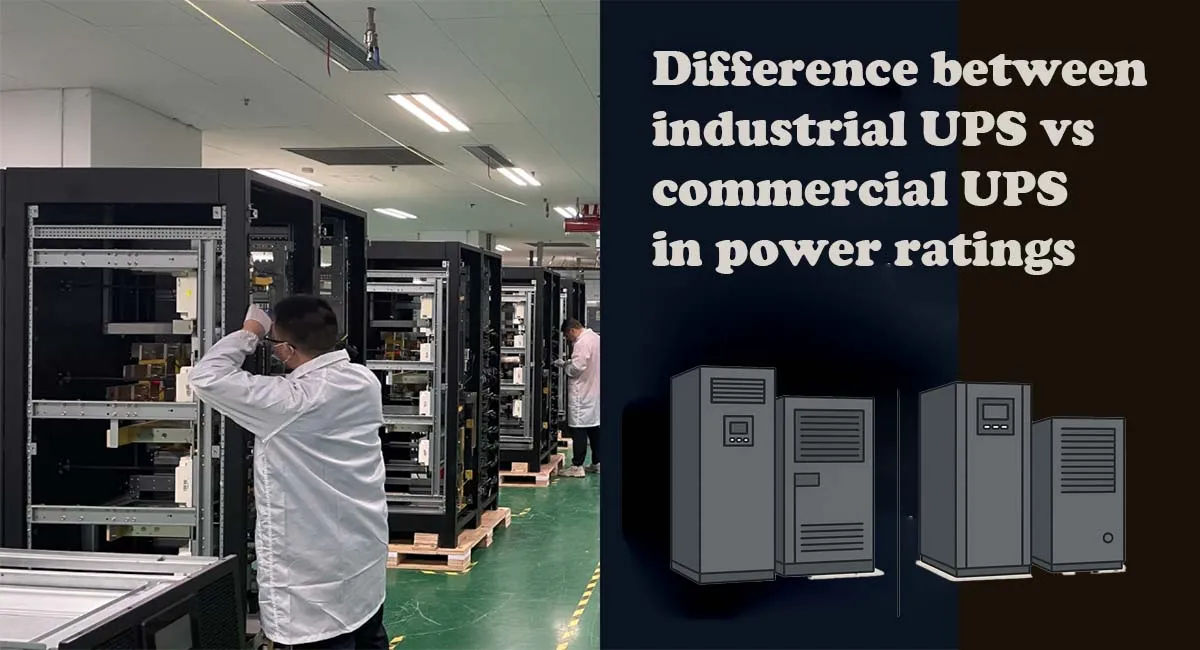
Virtue industrial UPS covers a power range from 10kVA to 900kVA. high power lithium UPS can provide reliable power protection for electronic equipment throughout entire workshops. Mainstream commercial UPS with power ratings between 1-20kVA, can meet the operational needs of everyday commercial equipment like computers and server rooms. We will balance equipment performance and cost based on the actual power requirements of your commercial environment. Of course, if your budget is sufficient and you have plans for future business expansion, you may prioritize selecting a 10-20kVA UPS. Alternatively, you can choose a lithium UPS that matches your current load and expand it later when your business grows.
Different overload capabilities
Industrial UPS vs commercial UPS load different equipment. The former primarily powers industrial machinery like cranes and large water pumps, which can draw currents up to six times of its rated value during startup. This means the UPS must withstand such instantaneous currents and ensure it does not trigger protective shutdown under these transient impacts. Therefore, industrial UPS power supply can operate for 10 minutes at 125% load and sustain equipment operation for 1 minute at 150% load. In contrast, commercial UPS typically run for 5-10 minutes at 125% load. If the load exceeds this threshold, it will switch to bypass or initiate shutdown protection. This is because commercial equipment exhibits relatively stable current during startup and operation, and does not generate severe current surges.
Different capacity planning
For industrial UPS systems, when providing power protection solutions to users, we will consider future development needs and typically recommend users reserve 30%-50% UPS capacity. Modular industrial UPS are designed with parallel power modules, each typically rated at 50-100kVA. Users can configure a base system according to current needs and extend capacity online by adding power modules without system downtime. In contrast, when equipped with commercial UPS, we will configure based on actual power requirements. Commercial lithium UPS systems typically feature compact designs. When existing UPS capacity cannot meet the demand, the most common method is to replace it with a new UPS with higher capacity. This means business operations must be interrupted, and the initial investment becomes sunk. There are commercial UPS systems that support parallel operation of 2-4 units, but its expansion capacity and technical maturity is not as advanced as industrial uninterruptible power supply.
How to choose the right UPS system for your applications?
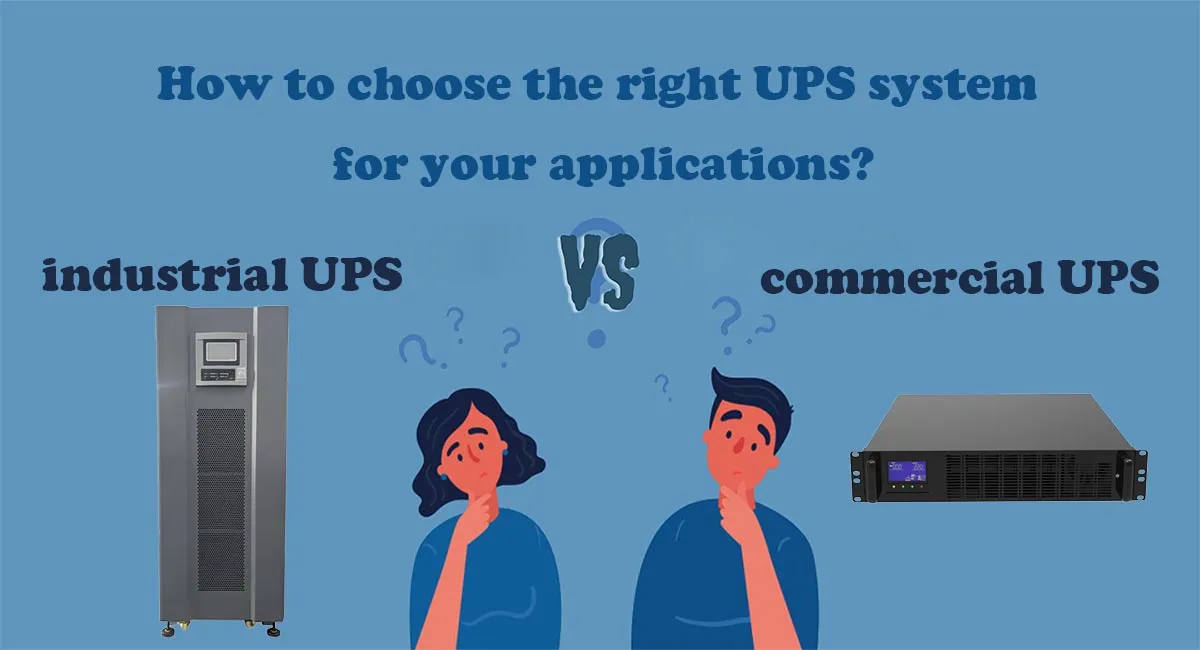
Before selecting industrial UPS vs commercial UPS, we should evaluate the actual application environment, such as temperature range, air humidity, dust contamination, etc. When the ambient temperature exceeds the 0-40°C range, humidity exceeds 80%, and the application environment involves vibration, industrial UPS is the ideal choice. In constant temperature and humidity environments, we can choose the more cost-effective commercial UPS.
Next is the type of load equipment. Industrial uninterruptible power supplies are specifically designed for inductive loads such as motors and compressors, which can withstand instantaneous overloads exceeding 150%. On the other hand, commercial power supplies are engineered for resistive loads like servers and network equipment, delivering outstanding performance in standard commercial environments. Besides, modular industrial UPS support online expansion, allowing power modules to be added incrementally when demand increases. If you are choosing a commercial UPS for your project, it is recommended to reserve a 25%-30% capacity for the lithium UPS. This is because commercial UPS have limited scalability compared to industrial UPS.
Conclusion
The fundamental difference between industrial UPS vs commercial UPS is the different application scenarios these uninterruptible power supply products match. In rapidly developing fields like smart manufacturing and data center infrastructure, the elastic scalability of industrial UPS can help enterprises adapt to changing power demands driven by technological iteration and business expansion, providing sustainable power support for digital transformation. Meanwhile, with lower upfront costs and simplified maintenance, lithium uninterruptible power supplies can meet commercial power protection requirements. It can ensure business continuity and maximize investment returns. A UPS that matches your application scenario not only guarantees stable, reliable power for critical equipment but also ensures the continuous development of your business.