How long does uninterrupted power supply last?
The question of how long does uninterrupted power supply last is crucial to the operational duration of our critical equipment. During emergencies such as earthquakes, fires, or utility power outages, uninterrupted power supplies provide electricity to critical equipment, ensuring its continued operation. However, many users are concerned about how long does uninterrupted power supply last.
The answer to this question is not fixed. Because it is associated with the mains power supply status, the power consumption of our load equipment, the capacity of the UPS battery, and the power conversion efficiency of our UPS. If the mains power supply is normal, the UPS can continuously provide clean power to the equipment. When the mains power is interrupted, how long the UPS with lithium battery can provide power depends on the battery capacity.
How long does UPS last without electricity?
Virtue 1kVA 2kVA 3kVA rack mounted UPS typically provide backup power for 30 minutes to 2 hours under half-load conditions. However, this does not imply that 6kVA, 10kVA and other power ratings lithium UPS can also deliver backup times ranging from 30 minutes to 2 hours. The runtime of a UPS power system is calculated based on the connected load equipment and battery capacity. We can provide UPS solutions with half an hour backup time, five or six hours backup time and more. We offer customized lithium UPS solutions based on your required backup time.
What factors affect the runtime of lithium UPS?
- Total power of load equipment: 6kVA rack mounted UPS can generally meet the needs of medium-sized enterprises and servers. However, the load equipment’s power varies, the time it can sustain operation also is different. UPS with the same power rating and battery capacity will provide longer runtime when supporting a 3kVA load compared to a 6kVA load.
- Battery capacity: The battery capacity is also one of the factors to consider when answering the question of how long does uninterrupted power supply last. If the built-in battery capacity of lithium UPS is high, it can provide power to equipment for a longer time when the utility power fails. For large data centers and automated production applications, users typically require uninterruptible power supplies with a long backup time. And we can provide UPS with the backup time you need.
- Conversion efficiency and lifespan of the equipment: If the UPS has high conversion efficiency, it means that the power consumed during the process of delivering battery power to the equipment is minimal. Therefore, the efficiency of battery power utilization is high. Additionally, UPS systems and batteries have a limited lifespan. As usage time increases, the lifespan and performance of the UPS will gradually decline. But you don’t need to worry. Our UPS and LiFePO4 battery have a longer lifespan than lead-acid UPS. This is why more and more users are choosing lithium UPS systems in the lead acid vs lithium comparison.
How to calculate your UPS runtime?
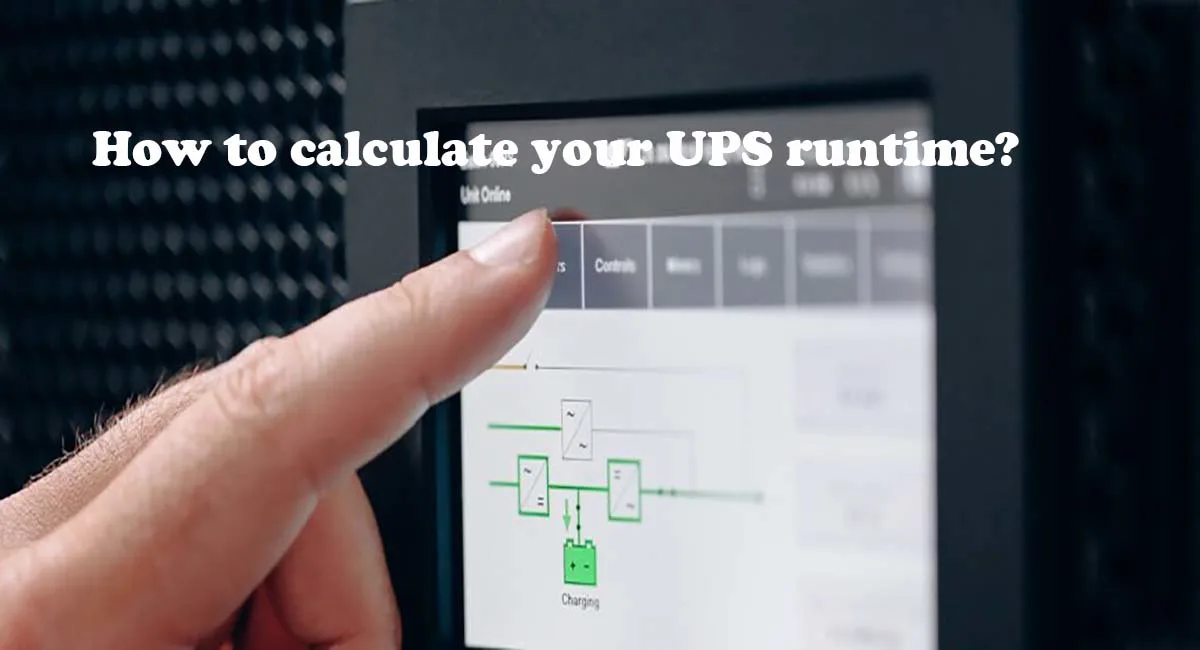
It is important to know the runtime of your UPS. This determines whether your files and data can be saved in time. It also determines whether your precision equipment can avoid hardware damage caused by sudden power loss. If you want to know the runtime of your UPS, you can consult the UPS supplier. Alternatively, you can check the backup time of your UPS on the product page of the supplier’s website. If you would like to calculate the UPS runtime by yourself, you first need to know the total power of the load equipment, the power rating of the UPS, and the capacity of the battery. For example, a 6kVA UPS with a 51.2V 100Ah lithium battery can sustain a 2kVA load for 2.5 hours. Additionally, you can provide us with information such as the model of your equipment, load power, and battery specifications, and we will calculate the runtime of your current UPS system for you.
How often should an UPS be replaced?
There are generally three scenarios for replacing a UPS. The first scenario occurs when the UPS exhibits significant performance degradation. At this situation, we need to replace a new UPS to protect the equipment’s power supply. The second scenario is the current UPS power system cannot meet operational demands. As business scale expands, critical equipment requirements increase. At this point, the total load of the UPS may approach or exceed its rated capacity.
Another scenario is that you want to upgrade your existing lead-acid UPS system to a lithium UPS. As a lithium UPS manufacturer, we can provide lithium UPS solutions to replace your lead-acid UPS systems. We have extensive experience in replacing lead-acid UPS with lithium iron phosphate battery. If you are looking a replacement solution for your specific application, please feel free to contact us.
Conclusion
How long does uninterrupted power supply last is a question without a single definitive answer. When responding to this problem, we need to perform calculations considering multiple factors. Accurately calculating the UPS runtime for equipment power supply is crucial for ensuring business continuity and data integrity. And if you want to forecast backup time more accurately, you can choose a lithium UPS. It can provide a smarter management system, allowing you to better monitor backup time and prepare emergency measures.