
As we all know, UPS solutions are directly linked to the continuity of our business operations. As a lithium UPS solution provider in China, when we supply lithium UPS systems to data centers, emergency centers, and corporate offices, we will help customers select the most suitable UPS redundancy level between N, N+1, 2N, and 2N+1. If you’re wondering why UPS redundancy is necessary, you’ll find the answer in this article. If you’re unsure which UPS redundancy level is right for your project, the answers can be found below. Of course, you can also contact us to obtain an uninterruptible power supply solution with the most suitable redundancy level for your project.
What does UPS redundancy mean?
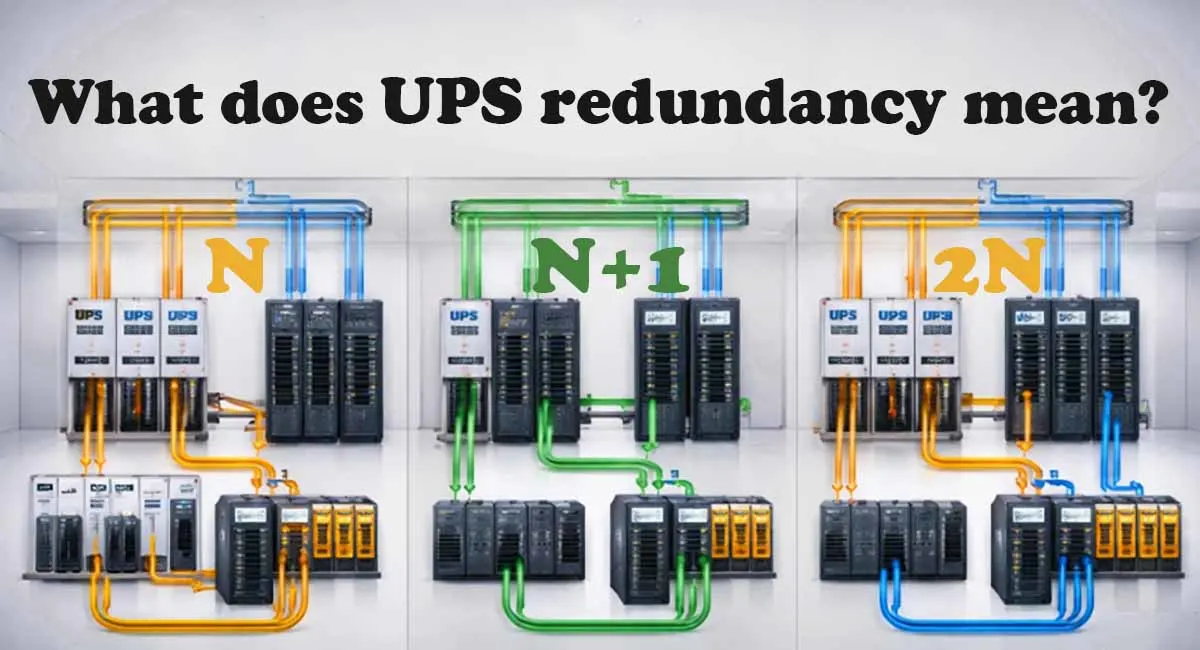
UPS redundancy means that when we deploy lithium UPS systems for actual projects, we will configure UPS units with a higher capacity than the actual load requirements. The reason why we choose to deploy lithium UPS units with higher capacity is to ensure that, in the event of a UPS failure or during scheduled maintenance, other UPS units can take over the entire load. As a result, the equipment can continue to operate without interruption. Simply speaking, UPS redundancy is installing one or more uninterruptible power supply units with the same capacity based on the actual required UPS capacity.
Why do I need UPS redundancy?
UPS redundancy can improve system reliability. Without UPS redundancy, the system will go down if one UPS fails or requires maintenance. But with UPS redundancy, if one UPS module in the system has problems, the other UPS modules will automatically take over the load, ensuring your critical equipment continues to operate. In critical scenarios such as healthcare and trading, a business interruption will result in significant losses. UPS redundancy offers a certain degree of fault tolerance for the power protection system. It can maintain business continuity when a single UPS fails. Additionally, lithium UPS systems with redundancy can achieve online maintenance. This means that operations can continue smoothly even during scheduled maintenance. At the same time, UPS redundancy provides scalable capacity to support your business growth. When expansion is needed, simply switch an existing redundant module to active status and add a new redundant module.
What are types of UPS redundancy?
N redundancy
Configuring the minimum number of UPS units based on current load requirements is N redundancy. In other words, the system has no additional redundancy. For example, if your project requires a 100kW load, configuring six 20kVA rack mounted lithium UPS units is N redundancy. The advantage of this UPS redundancy configuration is that it has a low initial purchase cost and avoids the waste associated with overcapacity. However, if one unit fails or requires maintenance, the entire UPS system will go offline.
N+1 redundancy
N+1 redundancy consists of installing an additional UPS module to meet the required load capacity. For example, to support a 100kW load, deploying five 30kVA lithium UPS is N+1 redundancy. During normal operation, each UPS handles approximately 20kW of the load. If any one unit fails, the remaining four units can handle a total capacity of 108 kW, which exactly meets the 100kW load requirement. And N+1 redundancy is currently the most common standard architecture for data center UPS systems.
2N redundancy
2N redundancy refers to the configuration of two independent UPS systems. Each system is capable of independently supporting 100% of the critical load. For example, if a project requires 100kW, the combined capacity of two lithium UPS systems would total 200kW. The greatest advantage of 2N redundancy is its system-level tolerance for failures. If one UPS system fails completely, the other UPS system can independently handle the entire load, ensuring your critical operations continue to run. At the same time, the entire chain from the distribution panel, UPS and PDU is backed up.
2(N+1) redundancy
2(N+1) redundancy consists of two independent UPS systems, and each UPS system uses N+1 redundancy. This UPS redundancy adds module-level redundancy based on system-level redundancy. For example, if a project requires 100kW load, each system uses four 30kVA lithium UPS modules to support the load, plus one 30kVA lithium UPS redundancy module. Two lithium UPS systems are each configured with five 27kW modules, providing a total installed capacity of 270kW. This UPS redundancy not only can withstand the complete failure of one system but also the failure of a single module within that system, achieving multi-fault tolerance.
Which UPS redundancy is suitable for my project?
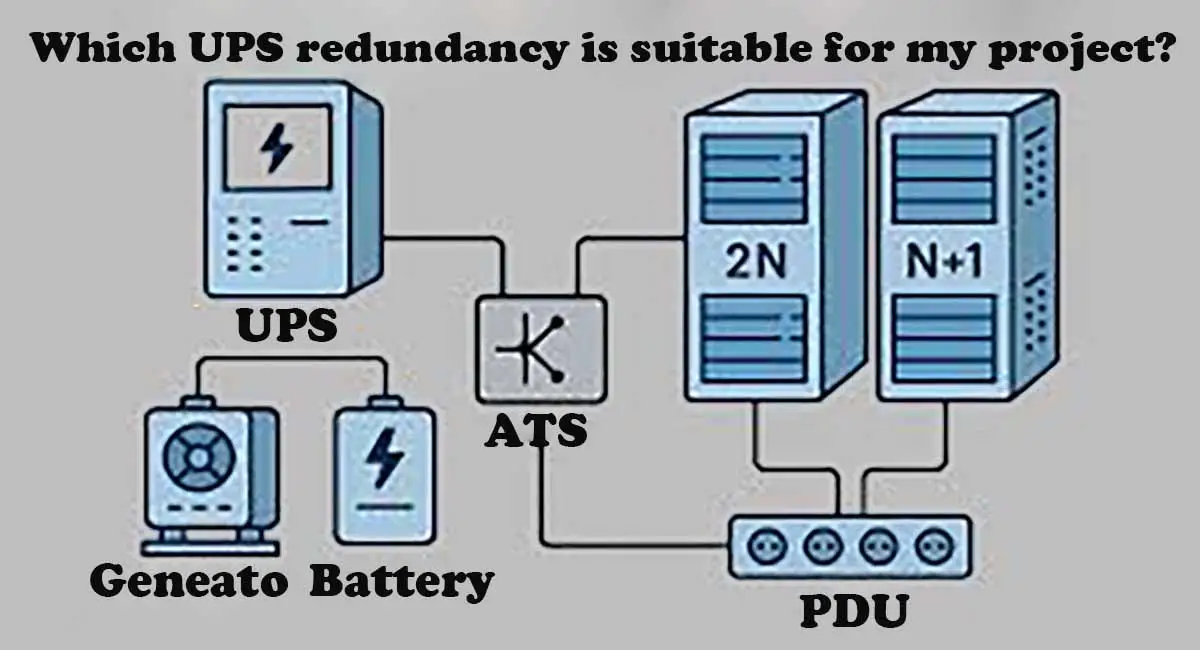
Different UPS redundancy levels meet different reliability requirements, cost investments, and operational complexities. For corporate offices, N redundancy is sufficient to meet operational needs. This is because such applications only require a power supply system capable of meeting current demands. It does not require high availability and allows for planned downtime. If you wish to enhance system reliability at minimal additional cost, N+1 redundancy is a suitable choice. For critical facilities requiring extremely high availability like Tier IV data centers, financial trading systems, and hospital operating rooms, 2N redundancy is the preferred solution. Meanwhile, 2(N+1) redundancy is the most expensive redundancy configuration and is typically used in critical scenarios where the cost of downtime is extremely high, such as financial trading, medical life support, and cloud computing services.
Conclusion
UPS redundancy is essentially the provision of lithium UPS systems with excess capacity for critical applications such as data centers and medical equipment, ensuring critical operations can continue uninterrupted even during power outages. If you are seeking the optimal UPS redundancy solution for your critical projects, please feel free to contact us via email or WhatsApp at +86 186 6492 6539.